Free shipping, dock to door · 90-day guarantee · Molded in Orange, California
The Yacht Cup Holder.com

Finally, somewhere to put your drink aboard.

4.9 from 119 Steadi reviews

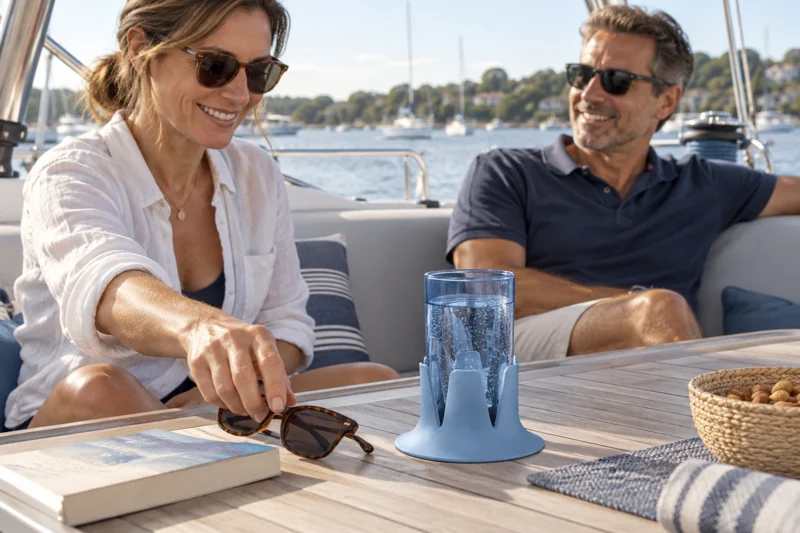
A flexible-finned base that holds your drink steady through the wake, the heel, and the raft-up — cockpit, sunpad, or helm. Nothing suctions, clamps, or drills into the boat.

Get one for the cockpit — from $14.95

Free shipping to the marina · 90 days to prove it holds · no drilling, ever

Will it fit before you cast off? The sticky-note test is below ↓

Prefer the maker's own store? steadilabs.com →

Left to right: the wide, low base empty, then holding a cup, a can, and a large tumbler.
One base, every seat aboard. Empty, then a cocktail cup, a can in its koozie, and the 40 oz tumbler — what actually comes out for sundowners, on the same base.

You've been here

Every trip aboard has a version of this roll.

Sundowners, just before dusk

The anchorage has been flat calm all evening. A boat comes in too fast, and half a minute later its wake rolls through, tipping every glass standing on the cockpit table at once.

The first gust after the sails fill

The boat settles onto its heel and the cockpit tilts. The molded holder in the table lets go at the same moment everything else not in a hand starts sliding to leeward.

Mid-afternoon at the raft-up

Three boats tied gunwale to gunwale, drinks parked on the sunpads while everyone steps from deck to deck. Each boarding step rocks both hulls and flexes the foam under every can.

Coming into the fuel dock

The helm needs both hands, wheel and throttle. The drink gets wedged behind the windshield brace, and the burst of reverse as the dock gets close sends it over.

Early coffee on the hook

The mug comes up from the galley out of habit, and the only holders aboard are shaped for something narrower — its handle finds no fin to sit in, so it waits on the swim platform, where the first wake of the morning finds it at the waterline.

How it holds

Built for a deck that never levels out.

The weight rides low and wide.

Cushion foam compresses unevenly and gelcoat is often canted or curved — either way, a narrow base has nothing level to stand on. The wide, low base spreads its weight across whatever's underneath instead of tipping off it.

The fins grip.

Flexible fins hold the drink by its bottom inch, from the sides, so a boarding step or a gust doesn't rattle it loose the way a shallow molded recess does.

It settles.

A gust heels the boat, a wake rolls through, someone steps aboard at the raft-up — the base's low, wide weight rocks with the motion and brings the drink back level instead of letting it ride the tilt.

Nothing clamps to the rail. No lifeline hook, no binnacle mount, no hole saw through the fiberglass. It sits on top of whatever's underneath — cushion, sunpad, table, or platform — and moves from seat to seat in a second.

Versus the fixes

Compared to what's already lashed to the boat.

A suction-mount marine cup holderThe Yacht Cup Holder
What surface it needsBonds to smooth, dry gelcoat only — cushion, non-skid, and canvas are off-limitsSits on cushion, non-skid, teak, or gelcoat alike
Past a real heelIts own instructions warn against resting past 25 degrees for long — ordinary sailing heel exceeds thatResists tipping as the boat settles onto its heel
If the bond lets goOne sailor reported it going overboard within the first hour, beer and allNothing suctioned to fail — the base and fins do the holding
On a dry, flat helm dashBonds fine there — that's the surface it's built forHolds steady there too
Where it can actually sitWherever the gelcoat is smooth and dry — often just the dashCockpit bench, sunpad, swim platform, dash — wherever a drink lands
When the raft-up fills every seatOne holder, one smooth spot — everyone else balances a drinkOne per person, wherever they end up sitting
After a season of sun and saltAdhesive backing and rubber gasket eventually dry out and crackOne piece of solid material — rinses off, nothing to crack
CostA separate gadget — another purchase to justifyOne small piece, not another fixture aboard
Suction-mount marine cup holders

They only bond to smooth, dry surfaces — cushion, non-skid, and canvas are all off limits — and one popular brand's own instructions warn against resting past 25 degrees for long, which ordinary sailing heel exceeds. One sailor reported the holder letting go within the first hour, beer and all, over the side.

Lifeline-hung wire baskets

In one published group test, a basket went missing — drink included — not long after getting underway, because the hook that held it to the lifeline was too open. The open wire frames also snag sheets, lines, and clothing.

Rail- and binnacle-mount holders

The nicer versions cost roughly ten times what a basic holder does, install with wrenches and Allen keys near steering wires, and testers cracked bushings just clamping a couple on. Even mounted, the drink lives at the wheel — not wherever the guests happen to be sitting.

Drilling in a bigger recessed holder

The factory-molded recesses are the ones owners already call too shallow and too wide. Sizing a new one to fit today's tumblers means a hole saw through the boat's fiberglass — and the hole serves exactly one seat, forever.

Fit, the easy way

Grab the pad by the nav station — that's the whole fit test.

your cup's base
lands in here

A square sticky note: 3 inches, exactly — same ceiling at the dock or on the hook.

01
Grab a sticky note.

The standard square sticky note is exactly 3 inches on a side — a fact about sticky notes, and it happens to be the ceiling of what fits.

02
Test the cup you actually brought aboard.

Look at the bottom, not the rim — a tapered tumbler or a flared cocktail cup can look wide and still have a narrow foot.

03
Read the note.

Base sits inside the square? It fits. Hangs over the edge? Too wide. A tiny puck lost in the middle, under 2 inches? Too narrow.

No guessing dockside — just a sticky note and the cup you actually bring aboard.

Will mine fit

The bottom inch decides what stays upright.

The rule is one line: a container base 2 to 3 inches across settles in, on deck the same as anywhere else. Every verdict below follows from it.

  • 40 oz Stanley-style tumbler fits
  • 30 oz YETI-style rambler fits
  • 12 oz can, koozied fits
  • 12 oz can, bare fits
  • Slim hard-seltzer can fits
  • Stemless insulated wine tumbler fits
  • Acrylic cocktail cup fits
  • Insulated water bottle fits
  • Pint glass fits
  • Espresso cup too narrow
  • Handled coffee mug handle in the way

There's a floor as well as a ceiling — under 2 inches the base sits too loose, same as it would on any table ashore. The handled mug is the honest exception aboard: the base size is right, but the handle lands exactly where a fin needs to grip.

The full fit database — Stanley, Red Bull, Yeti, and 30 more, with sourced base measurements →

Aboard, surface by surface

The whole room moves. All five surfaces come along for the ride.

The reason drinks fail aboard isn't clumsiness — it's that nothing underneath them stays level for more than a few seconds at a time.

Cockpit bench cushions

Vinyl-wrapped marine foam, crowned to shed rain and stitched at the seams — springy enough that a can sinks and tilts the moment it's set down, with rarely a molded holder within reach of the bench itself.

Sunpad

A wide field of vinyl and foam with no rigid feature anywhere on it, and the farthest spot on the boat from any console holder. Every elbow and every boarding step flexes the pad under whatever's balanced there.

Cockpit table

Solid teak or molded fiberglass, bolted rigidly to a hull that heels and rolls. The shallow drink recesses molded into it were sized for smaller cups, and under any real heel the tabletop turns into a ramp.

Gelcoat deck and swim platform

Mirror-smooth in places, molded non-skid in others, and regularly wet with spray or dripping swimmers. A sweating base skates on the smooth gelcoat, and the textured non-skid that keeps shoes planted is exactly what a suction cup can't hold onto.

Helm console

Angled fiberglass that vibrates under power, with molded holders sized decades before insulated tumblers got this big. A modern 30 to 40 oz cup doesn't seat in them, so it rides loose on a slanted shelf.

Why drinks go over aboard a yacht — and what actually holds one steady — the full story →

From the reviews

What buyers say.

Recent reviews of the Steadi, from every room and rig it lives in.

★★★★★

I have a tendency to spill my drinks and have two cats. This is one of the best things I’ve ever impulse bought. It works. It actually works. It’s a heavy, wide enough base that it is actually stable. My “spot” in the living room is near a somewhat-cushioned fabric ottoman, which is where I usually put my drinks. It’s

Dixie · 2026-08-30
★★★★★

I love mine. I just wish the price was more appropriate. $15 seems a lot for a small plastic item. Reduce it to $9.99 and free shipping and I'll buy a few more!

Carolyn G. · 2026-08-27
★★★★★

Excellent!

Brian S. · 2026-08-27
★★★★★

Thank you for your service!

Brian S. · 2026-08-27
★★★★★

It’s great love it

gilbert a. · 2026-08-24
★★★★★

I never knock over my water at night anymore!

Customer · 2026-08-21

Read all 119 reviews →

All 119 reviews are for the drink base itself, collected across every place people use it.

Why more than one

Two identical tumblers on the rail. Whose is whose?

At a raft-up with two or three hulls tied together, half the guests are already drinking out of the same size YETI or Stanley everyone else brought aboard. Set two identical tumblers down on the same cushion and there's no way to tell which one's yours without checking — and nobody wants to be the one reaching for a drink off someone else's boat.

Build your set

Give everyone their own.

Pick a pack, then give each one a color — so nobody has to ask which drink is theirs.

Honest answers

Questions asked dockside, answered here.

Does it actually hold on while heeling or underway?

That's the reason it's shaped this way. The wide, low base spreads across cushion or fiberglass instead of needing a level surface, and the flexible fins hold the drink from the sides. Heel into a gust or take a wake broadside and it resists tipping — its weight rides low enough that it rocks and settles instead of going over.

I've had a suction-cup holder let go before — is this different?

Different mechanism entirely. Suction only bonds to smooth, dry surfaces — it can't grip cushion, non-skid, or canvas, and most brands warn against much heel at all. This one doesn't suction to anything; the wide base and the fins do the holding, on wet gelcoat or foam alike.

Will my 40 oz tumbler actually fit? My console holder won't take it.

Measure the bottom, not the rim. A base 2 to 3 inches across settles in here, and the 40 oz Stanley fits — the same size that outgrew most factory console holders.

Does it clamp to the rail, the lifeline, or the console?

No. Nothing clamps, mounts, or gets drilled into the boat. It sits on top of whatever's underneath and moves from the cockpit to the sunpad in a second.

Where aboard does it actually work — just the cockpit?

Wherever a drink lands: the cockpit bench, the sunpad, the cockpit table, the helm, the swim platform. It doesn't need a dedicated seat or a factory holder built into that spot.

Does it work on hard surfaces like the helm dash, not just cushions?

Yes — it works at least as well on hard, flat fiberglass as it does on foam. That's useful right where the older molded holders are the most likely to be too small for a modern tumbler.

A wake catches us broadside sometimes. Does that end it?

Motion is the whole design brief. The base rides low and wide, so it rocks with the roll and brings the drink back level. It resists tipping — it isn't magic, so a direct hard knock is still a direct hard knock — but an ordinary wake rolling through the anchorage is exactly what it's built to shrug off.

How do I clean it after a day on the water?

Rinse it, wipe it down, or put it in the dishwasher. It's one piece of solid molded material with nothing to come apart and nothing for salt or spray to get into.

Who makes it, and where do I buy one?

It's called the Steadi, molded in small runs in Orange, California by Steadi Labs — veteran-founded and patent pending. Every order ships free from steadilabs.com, with 90 days to change your mind.

All 18 questions, answered →

Origin

Molded a few miles inland, made for life on the water.

The maker is Steadi Labs, a small veteran-founded company in Orange, California. It's injection molded in small runs, and nothing about it travels far before it heads out toward a dock somewhere: the mold, the material, and the color runs all sit within about three and a half miles of the shop. The people who make it read hello@steadilabs.com themselves, usually between runs.

Ninety days, however many trips that is.

Take it out for a month. If it doesn't do what this page says — in the cockpit, on the sunpad, at the raft-up — email hello@steadilabs.com and it gets made right. No forms, no fight.

Veteran-founded · Patent pending · Made in Orange, California

Let the boat move. The drink doesn't have to.

Heel, wake, raft-up — the drink rides out all three right where you set it down: cushion, sunpad, swim platform. By evening, the only thing wet on the cockpit sole is spray.

Stock the boat — free shipping, every order

Checkout happens at steadilabs.com — Steadi Labs is the company that makes it.